
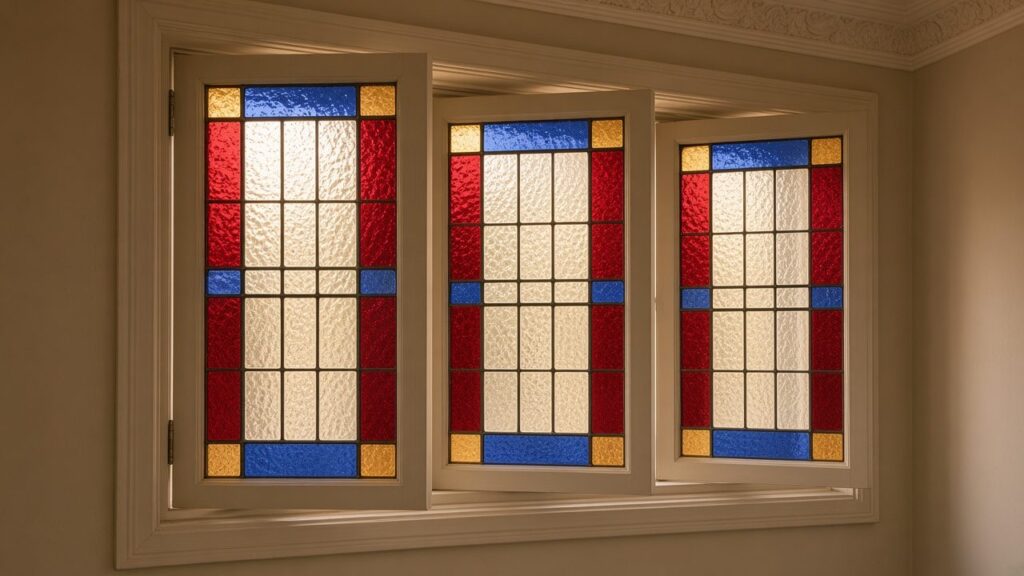
A new leadlight window can do a surprising amount for a home. It can tie a new extension to an original Victorian front, bring colour into a plain hallway, give a bathroom privacy without losing light, or become the centrepiece of a new home’s entry. Verity Leadlights has designed and made new leadlight windows for Melbourne homes since 1979. Every panel is made in our workshop at 82 Derby Street, Kew, using traditional methods that will last for generations.
Where new leadlight works well

- Front entries: doors, sidelights and highlights designed as a set
- Stair landings and hallways, where coloured light lifts a dark space
- Bathrooms and ensuites, for privacy without losing daylight
- Street-facing windows, to soften the view in and keep rooms bright
- Kitchen cabinets, display cabinets and bookcases
- Internal windows and doors between rooms
- Panels beneath skylights, bringing colour from above
Designing your leadlight

Starting with the house
The best new leadlight looks as though it belongs. We start by looking at the era and style of your home. Victorian houses suit coloured margins and jewel-like tones. Federation and Edwardian homes suit flowing Art Nouveau lines, Australian flora and opalescent glass. Interwar homes suit restrained geometry in textured clear glass, and Art Deco homes suit stepped forms and sunbursts. Contemporary homes can carry bold abstract work, or quiet panels of clear textures and bevels.
Light, privacy and the view
Good design also considers how the window is used. In a bathroom, you might want most of the panel in textured glass, with colour only in a border. On a stair landing, more colour can work because the window is mainly there for light. On a street-facing window, the balance between privacy and outlook decides how much clear glass to include. We talk through how each room is used before settling on a design.
Working from your ideas
Many customers come to us with a picture from a magazine, a sketch or a favourite window from another house. We can turn an idea into a design that works in glass and lead, adjusting proportions so it suits the size of your window and is strong enough to last.
Matching what is already there
If your home has original leadlight, new panels can reproduce or echo it. This is common in renovations, where new rooms at the rear need to feel connected to the original house at the front.
Choosing the glass
Glass has more effect on the finished window than any other choice. Cathedral glass is transparent and textured, opalescent glass is milky and diffuses light, and clear textured glass gives privacy without colour. Bevels catch the light and throw small rainbows. We keep a large range of glass in stock, and we recommend looking at samples against the actual window before you decide. A north-facing window gives warm, bright light, while a south-facing window gives softer, cooler light, and colours change accordingly.
Built the traditional way
We make new leadlights the traditional way: glass cut by hand to a full-size drawing, joined with lead came, soldered at every joint, then cemented to seal and stiffen the panel. These methods have proven themselves over generations, and panels made this way can be repaired and re-leaded well into the future.
Safety glass and AS 1288
Australian Standard AS 1288 sets out where safety glass is required in buildings, including many doors, sidelights and low windows in areas where people could walk into the glass. Leadlight can still be used in these locations when it is combined with suitable safety glass, for example as part of a triple-glazed unit. We can advise on what applies to your project.
Insulation and noise
New leadlight can be triple glazed, adding layers of clear glass that protect the panel and improve insulation and noise reduction. This is worth considering for windows on busy roads or for large entries.
Working with builders and joiners
For new homes and renovations, involving us early helps. The thickness of the finished panel affects the rebates in doors and window frames, especially where leadlight is combined with safety glass or triple glazed. We often work with builders, joiners and kitchen companies, and can measure on site or work from the joiner’s dimensions.
From design to installation
Once the design and glass are approved, we make the panel in our workshop and install it. We will talk you through each step, from the first measure to the finished window.
Looking after a new leadlight
New leadlight needs very little care. Clean it gently with mild soapy water and a soft cloth, avoid abrasive cleaners and high-pressure hoses, and fit a door stop or closer where the leadlight is in a door. Cared for this way, a well-made panel will serve your home for a very long time, and if it is ever damaged it can be repaired, because traditional leadlight is designed to be taken apart and rebuilt.
Frequently asked questions
Yes. We design leadlight for Victorian, Edwardian, Federation, interwar, Art Deco and contemporary homes, and can work from your ideas or our own designs.
Yes. We recommend looking at samples against the window where the leadlight will go.
Yes. Leadlight can be combined with suitable safety glass to meet AS 1288.
Yes. We make panels for cabinet doors and furniture, and work with joiners and kitchen companies to fit them.
Yes. We make each panel in our Kew workshop and install it.
Related pages
- Leadlight and stained glass window reproductions
- Leadlight doors
- Triple glazing of leadlight and stained glass windows
- Leadlight windows and 5 star energy ratings in Melbourne
- Federation leadlights, doors and windows
- Art Deco leadlights in Melbourne
Start your new leadlight window
For new leadlight windows in Melbourne, call Verity Leadlights on 03 9853 8611 or 0418 395 628, or visit our workshop at 82 Derby Street, Kew VIC. We have designed and made leadlights since 1979 and are highly rated by our customers. Please ring before visiting, as we are often out on site.


